Thursday, July 05, 2012

Wir fahren fahren fahren auf der Autobahn


We drive drive drive on the Autobahn*

The German Autobahn: drive as fast as you want but beware of even faster cars coming up behind you. Well, except when there actually is a speed limit and when there is stau. One of the first words we learned here is "stau", which means "traffic jam."


And it's often because of this:


But the roads that aren't under construction are in really good shape, much better than the average U.S. highway. In the U.S. we'd need to have these two signs posted just about everywhere - they mean "road damage":


This sign is what many drivers want to see on the autobahn. It means there is no speed limit:


There is an advisory speed limit of 130 kilometers per hour (81 mph) on the autobahn but I can tell you that many people drive much, much faster when they are able. You'd think at those speeds there'd be accidents all over the place. There aren't because the Germans adhere to the policy that slower vehicles drive in the far right lane, and you only move to the left lane to pass. That's supposed to be the law in the U.S., right?  Well here in Germany, you really do only move to the left lane to pass and then you better get back over to the right or you'll have an Audi or a Mercedes or even a little VW in your rearview mirror when you thought for sure no one was back there when you checked before passing. You are also prohibited from passing on the right except when there is congestion. This makes the flow of traffic much more predictable - really important because when you drive at higher speeds reaction time is critical, and the last thing you want is to have someone do something unpredictable when you're driving over 100 mph.

One thing I'm pleasantly surprised at is that the truck drivers here are not aggressive drivers - or at least we have not witnessed this. If you've driven I-95 along the eastern U.S., you know the feeling of being nearly (or actually) squashed by the trucks. What I've experienced here in Germany as well as in France is that the trucks stay in the far right lane and drive almost convoy-style. They have a strict speed limit of 80 km/hr (50 mph). They do occasionally pass slower moving trucks and this sometimes causes congestion, especially on 2-lane autobahns, but it's temporary. Trucks from all over Europe drive through Germany and at first it was entertaining to discover where they come from: Poland, Turkey, Slovakia...but now I'm used to the international mix of trucks. Just one warning though - be prepared for the rest stops to be jammed with trucks on holidays and Sundays as they are not permitted on the roads before 10:00 pm. I did not know this until I did some research (i.e., Wikipedia) about the autobahn.

And what else did I learn about the autobahn from Wikipedia? The idea for the autobahn was conceived following WWI but didn't progress until Hitler embraced the project just after the 1933 Nazi takeover. I was surprised to learn that the autobahn was not intended as a major infrastructure for the military since military transport of goods was done via rail to save on cost. However, as the first limited-access, high speed road network in the world, the autobahn was a propaganda tool and was used to attract international attention. The first section opened in 1935 and was from Frankfut to Darmstadt - we've driven that route! Another bit of trivia is that one of the highest speeds ever achieved on a public motorway was set on this section of autobahn: 432 km/h (268 mph) set by Rudolf Caracciola.

*Lyrics from the 1975 song Autobahn by Kraftwerk. I remember this band and this song because my sister had an album by Kraftwerk with this song on it. Now wir fahren fahren fahren auf der Autobahn.

Wednesday, July 04, 2012

Happy 4th of July

Happy 4th of July to my American friends and family!

Instead of eating hotdogs and hamburgers and watching a fireworks show, we ate a giant pretzel, drank German beer, and saw lightning. We spent the holiday in Munich, Germany. I have not downloaded the pictures yet, but will hopefully do so soon.

Tuesday, July 03, 2012

Bad Homburg

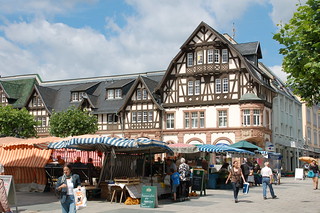
I accompanied my husband on a work-trip to Bad Homburg last week. Bad Homburg, full name Bad Homburg vor der Höhe, is located just northwest of Frankfurt. It's reportedly one of the wealthiest towns in Germany, probably because it's home to executives who work in Frankfurt and also because of its mineral water, spas, casino, and the lovely setting at the foot of the Taunus, a low mountain range. There's a fairly decent-sized shopping street and being that it's a tourist-type destination there are plenty of Eis Cafes (ice cream shops) as well as quite a few stores selling bathing suits, jewelry, or decorative house accessories. I did a bit of window shopping and bought a few minor things (no bathing suits, jewelry or decorative stuff) but mostly I spent time walking around and visiting the parks. There are two beautiful, well-maintained parks in Bad Homburg: Schlosspark and Kurpark. The Schlosspark is the grounds of the Landgräfliches Schloss (Count’s Castle) and has a pond, walking paths and benches in addition to the castle, which I didn't visit. We may go back there for more work-trips so maybe I'll make a point of taking a tour then, when my German is better. I just enjoyed walking the grounds and sitting near the pond. Kurpark is quite large and had many walking paths, benches, a large pond and also contains the mineral spa, casino and a variety of buildings and monuments dating from the early 1900s. Most of these buildings contain taps for accessing the mineral water. The Royal-Kur spa looks like a luxurious place to visit. Maybe next time. I visited this park a few times to escape the muggy heat.

Market day in Bad Homburg, Germany

Market Day in Bad Homburg

Bad Homburg

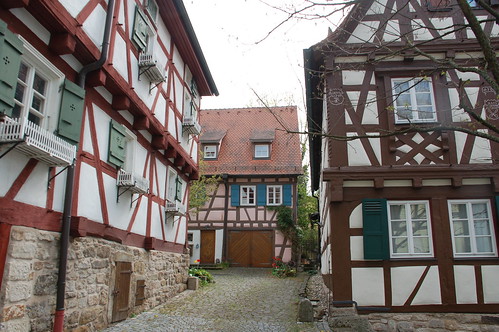
One of the old, decorative buildings in town

Bad Homburg

In the early 1900's when the narrow, crooked streets of the old, medieval part of town became a problem for the growing city, they built a bridge over it rather than destroy the old houses.


Bad Homburg

The "new" (built in 1905) towers at the end of the bridge over the old section of town.

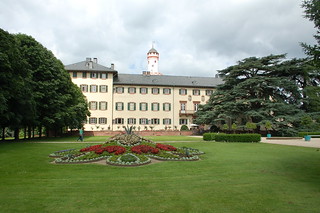
Landgrave's Castle, Bad Homburg

The Landgrave's Castle, built in 1680 on the grounds of a 14th century castle. The white tower is all that remains of the previous castle.

Bad Homburg

Bad Homburg
There were lots of baby water fowl in the parks
Feeding Time


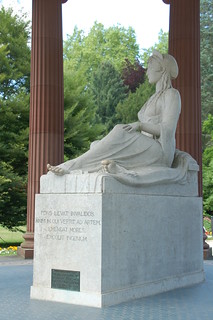
Bad Homburg Bad Homburg Bad Homburg Mineral water in Kurpark, Bad Homburg

Some of the structures and statues in the Kurpark. The center, glass cylinder in the two bottom photos display the bubbling mineral water. The lower left photo shows one of the water stations where you could sample the water or fill a container. I tried it and found it quite bubby and mineral-tasting, as expected!


More photos on Flickr

Monday, July 02, 2012

The Produce Man

My husband and I have temporarily relocated to Germany, at least through September but maybe for longer. We've settled into a furnished apartment in a lovely area in the hills of Stuttgart. It's a vacation-like setting where one hears the constant chirp of birds over the low whoosh of a nearby, but not too near and not too busy, roadway.

Today it is raining. The many trees around us are green and dripping with moisture. It's early, and people are leaving for work so the bird chirps are combined with the occasional sound of doors closing and car engines starting.

As I was getting ready for my day, the morning sounds were overcome by the sharp tone of a bell - not a churchbell, but a hand bell. At first I thought it was the landlady calling for her cats, but then I heard a male voice calling out something I couldn't understand. It was clear that he was announcing something. I looked out my window to see a man in green coveralls walking up the street towards a produce truck. A market on wheels! The back of the truck was set up just like a produce stand. It was open on three sides with colorful, layered tiers of vegetables and fruit. A canvas canopy was rolled up at each of the openings. Since we live in a residential area in the hills, going to the market means walking down the steep hill - and of course trudging back up laden with heavy bags. But apparently at least this one produce truck comes to us. I would have run down the stairs and out the door to buy some fruits and vegetables but I'd just gotten out of the shower. I also don't know German very well (yet) and am very shy at trying to communicate - I know, I know, I won't learn if I don't try but it was early, and I was low on euros anyway. So instead I watched out the window as a woman approached the truck. I watched as she spoke to the man and he retrieved a carton of eggs and a few small plastic bags of produce. She placed them in her bag (always have bags with you when you shop in Europe) and exchanged money and after a few "Guten Tags", that was that. Having no more customers, the produce man got back in his truck and left. I was amazed that nothing spilled out as he turned the corner and drove away. I heard the ringing of his bell a few streets over as he repeated his morning ritual.

Hopefully this is a weekly occurence so next week when I hear the bell ringing, I'll be fully dressed and able to grab my euros and my shopping bag and buy some produce.

Wednesday, May 02, 2012

In Germany

I am spending some time in Germany this summer! Here are some pictures of a town called Sindelfingen. The weather has been very nice and the tulips are all in bloom. There are a lot of nice, old timberframe buildings.

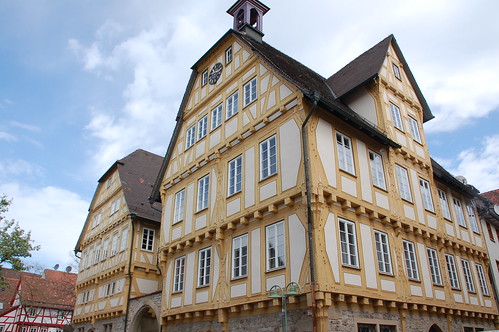
Sindelfingen

This one is the Stadt Museum and dates from 1592

Sindelfingen
There are tulips everywhere, including the center of a traffic circle.

Sindelfingen

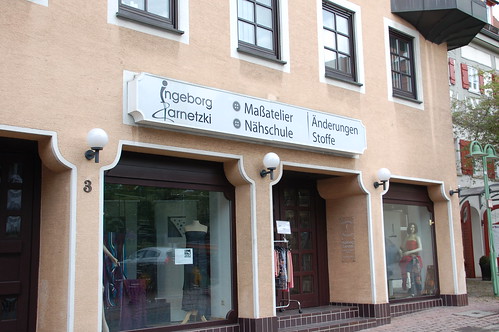
I have seen a few fabric stores and yarn shops but I have only bought some circular needles I needed for a knitting project I brought. Here is a fabric (stoffe) store in Sindelfingen.

Sindelfingen

I posted more pictures on my Flickr page.

Friday, April 20, 2012

More dreaded home dec

So I'm headed to Germany next week for 2 weeks and what am I doing tonight instead of packing or getting a knitting project ready to take? Making Roman shades. And writing a blog entry!


The shades are for the French doors in the back of the house, which let in a lot of light. While the light is great to have, it's not very forgiving on any fabrics I may leave out on my cutting table in the direct sunlight. The room also doubles as a guest room and it's not very private with only the sheer drapes I made last year:


The shades have been on my To-Do list for a while and I already had the fabric, a light purple seersucker. I even had lining in my stash. I found this Roman shade kit on clearance at Joann's and I hoped it would help quickly me make these shades. Well, not quite.  


The kit includes enclosed lift tape, which is cording encased in a thin strip of some polyester type fabric. There's also some hardware: screw eyes, shade rings, cord cleat, cord condenser and some brackets for mounting a board. (I ended up only using the lift tape, shade rings, and cord condenser). After reading their instructions, I decided that using just the kit to make the shades wouldn't result in the shades I really hoped for. First, the instructions don't call for any battens or rods to be used to help the shade fold properly. Also, they suggest stapling the shade to the mounting board and using the enclosed screw eyes for the lift cord. Since my French doors open outward, I need to be able to wash these shades when they get dirty. So, I searched the internet for other options and found some good sources. I found this video particularly helpful for overall instructions on how to make the shades:

 
I like the hardware calculator on www.terrelldesigns.com and ordered flat pulleys from them to use instead of screw eyes. I decided against the cord lock since they warned that it can fray the cords over time. I maybe should have ordered them because the alternative is to use a cord cleat and that means putting more holes in the door for the cleat. Drilling a hole in a door feels more damaging than drilling a hole in a wall. I started to use the instructions on Terrell Designs but they glue their battens (rods) onto the shade. Really? Glue? Again, I need to wash these shades, so I don't know that glue is the best way for me to put battens on the blinds.
 
As for the battens, some people use wood dowels but they can be pricey and not very straight. Terrell Designs carries battens, but I'm fortunate to have a TAP Plastics near me where I was able to buy 3/16" acrylic rods at only about a dollar per 6 foot rod.
 
Ok, back to slip stitching the lining to the fabric. These blinds are quite tedious, but I think they'll look great when I finally get them finished and installed.

Monday, April 02, 2012

WIPs and FOs

I know I've been neglecting this blog. I have been knitting and weaving, and although I'm not sewing, I am cleaning up the sewing room and hope to maybe squeeze something out in the next month. Changes are in the air and as a result I may only have a month to sew before the sewing machine is unavailable until next fall. Of course I've been sewing very little over the last few years so not sewing for 5-6 months will be nothing new.

But here are some works in progress and a finished object:

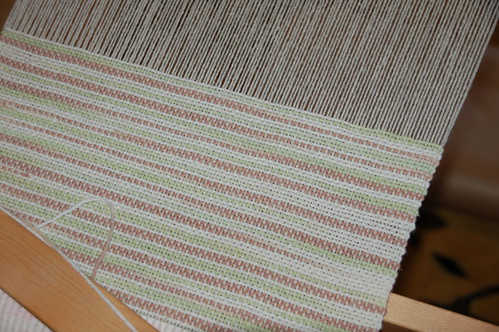
Placemats that I wove on my rigid heddle. They're off the loom, but I haven't cut them apart yet and finished them completely. The weft yarn is Lily Sugar n' Cream and the warp is recycled cotton/acrylic/wool from a failed knitting project.

DSC_0472


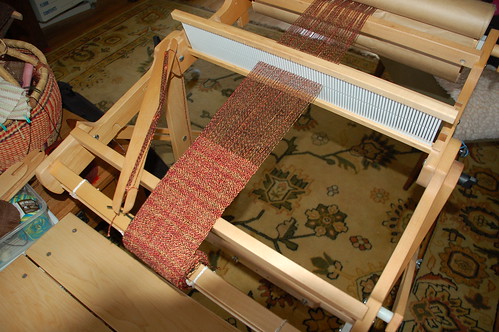
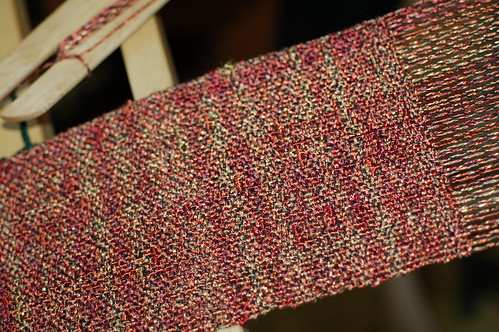
Here's a scarf that's just about finished on the rigid heddle. Or maybe it'll be a sash/belt. The weft and warp yarn is rayon from Valley Yarns Brilloso. This was a big lesson learned - this yarn has a black thread plyed with it that was not really strong enough to withstand being passed through the heddle. Sometimes the black thread would break and it caused a big mess. The other lesson learned was not to use slubby yarn as the warp. I didn't know this yarn was slubby - the first hundred yards or so was relatively smooth. After I warped about 6 inches, slubs started appearing every 12-15 inches. Like a newbie weaving idiot, I kept warping. I ended up unwarping all the slubby stuff and what you see is what I left for the warp width. 

DSC_0478

DSC_0474

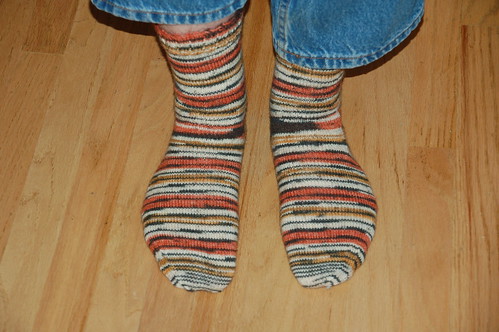
And finally, here are my husband's Tiger Socks. The yarn is Opal Zweger Garn Rainforest. I used size 1 needles and cast on 76 stitches. The ribbing is 2x2 and the body of the sock is stocknette, the heel is Eye of Partridge.

DSC_0459