Thursday, August 04, 2016

Copenhagen Fabric and Yarn "Hop"!

I'm a little late getting around to this post - time flies! In May I went to Copenhagen, Denmark and had my own little "hop", visiting a number of fabric and yarn stores in the walkable area around central Copenhagen. I always intended to blog about it and now I'm finally doing so.

I'd been to Copenhagen once before and visited the "must-see" tourist places, so this time, while my husband was busy during the day attending and speaking at a conference, I indulged my fiber-appetite and went exploring. Since my yarn and fabric stash is already bulging, I didn't need to shop, however a little bit of shopping did happen.

Prior to the trip I did some research and made up a list of stores to visit. Sadly I found a few were no longer in business, but I did stumble on one new one. Most importantly, it was a great way to tour the city and see some neighborhoods I might otherwise have never seen. I plotted the addresses using HERE maps and saved them as a collection. But since I don't know how to share this collection, and some of the stores are gone anyway, you should probably use your own mapping software if you want to go on a similar hop. If I can figure out how to share the map, I'll update this blog with the link.


I started with the first location in the lower left on Dybbolsgade since it was closest to the hotel and then went in a clockwise direction to visit, or attempt to visit, the rest. The very first location was, in fact, a bust! I could not locate the store and believe it is gone. I'm listing them here in case someone visiting this blog has found the names of those stores on other sites, like I did.

1. Stofresten, Dybbølsgade 68

GONE! I'm pretty sure I found the right address, but I didn't find a fabric store.

2. Stoff 2000 Vesterbrogade 41

New! - Not on my list but right down the same street from the next store on the list and the one I was intending to find.

The Stoff 2000 stores appear to be a chain in Denmark - there is also one later in my tour and when I was researching stores I came across others that are farther from the city center. I popped in and browsed briefly. This store in particular is fairly small, but they have garment, home dec, and quilting fabrics as well as the usual notions. Overall it's a nice, clean, well presented fabric store, it just doesn't have a large selection. I would probably consider this a "go-to" store for general sewing though.

Terrible photo, but at least you can see the sign
 3. Stoff&Stil, Vesterbrogade 20

This is a chain store as well, with stores in Denmark, Norway, Sweden, and Germany (and it turns out there's one a couple hours from me in Cologne). What struck me first about this store was how clean and well lit it was. The fabrics are displayed in rolls by fiber content and color. It's a large store compared to the other fabric stores I visited, but it's still in the city, so maybe not as large as their other chains might be. Thought they looked to have a decent selection of fabrics for garment sewing, including some youthful prints. I browsed but didn't stay long because I had a lot of stores to visit on my list. In the back section they have lots of notions, some craft supplies, and interesting kits with printed fabric panels, which were tempting but I didn't buy any. They also have yarn and a large selection of what look like their own knitting patterns and sewing patterns.


Note the long row of shopping carts!
 
Well lit and very clean!
Lots of knitting patterns

From here I walked north along the canal. It was a beautiful day!

May in Denmark is still spring.

Lovely flowering trees

4. Textilhuset, Fredriksborggade 39

GONE! No sign of this store anymore, however there is a Panduro Hobby at Fredriksborggade 36, which can satisfy some sewing and knitting needs as well as probably every other crafting need.

5. Stoff 2000, Fredriksborggade 26.

This is a larger store of this chain, with two separate sections for garment fabrics and home dec fabrics.

Bonus! Right across the street is the Torvehallerne food market. Perfect for a lunch stop!

6. Uldstedet, Vendersgade 3

This was the first yarn store on my tour. It's a fairly small shop with some nice yarns, some imported (Rowan, Katia) and some Danish (Isager). I browsed but didn't buy anything.

Worth stopping by if you're in the area!

7. Stofdillen Aps, Nørregade 36 - GONE!

8. City Sycenter, Rosengården 9

The information I found online had this at number 12 and from the description I think it once was larger than it is today and perhaps occupied buildings on both sides of the street. I could only find the small (very small!) store at number 9. But it was worth stopping. They happened to be having their anniversary sale so fabrics were 20% off. I found some knit remnants I really liked and also some sock yarn that is a mix of wool and nettles. I've never seen yarn made from nettles, so I had to buy it - it's very soft!


Knit fabrics with some interesting texture

Yarn from nettles!

9. Skipper Stoffer, Gammel Mønt 19

This is a dangerous store. Designer fabrics! Oh my. But at about $30/meter (200 DK), I knew that I wouldn't be buying some just to buy designer fabric. There were some beautiful fabrics, but nothing that I had to have, especially since I have quite a backlog of projects and a fabric stash on two continents. I did see names like Pucci and Armani...but I walked away.

Designer fabrics!

10. Handler, Vingårdstræde 19

If you find yourself in Copenhagen and are in need of trim, zippers or buttons, this looks like the place to go.


Fairly non-descript building hiding a rainbow of color inside!


Zippers!

Just one small, colorful section of trim.
Only open from 10 am to 4 pm, Monday through Friday, but there is a website...in Danish only.

11. Sommerfuglen, Vandkunsten 3

This was the one yarn store I had visited when I was in Copenhagen the first time a few years ago. I remembered that they had Hanne Falkenberg kits - she's a Danish knitwear designer and I recall her kits being popular, albeit expensive, purchases among the knitters at the Stitches knitting conventions. Since the kits are about 1/2 the price when you buy them in Europe, I thought maybe I would buy one from this store. But ultimately I changed my mind when I saw an Isager (another Danish designer) sweater sample on display in the store. I purchased the yarn for it and was able to buy the English version of the instruction book online after I returned home. It's from the book "Amimono Room 606", if you're interested.

Nice yarn store close to the center of Copenhagen
This is the sweater that caught my eye

Yarn for the sweater

Yarn for the cuffs and bands and back yoke

 12. I.W. Hvidberg, Løngangstræde 25

The last stop on my grand fabric and yarn store tour is actually the oldest fabric store in Denmark and maybe even Europe. It dates from 1780. I was a bit intimidated when I stepped inside, because it looked as if it was only a place for ordering fabrics for suits that they would then make for you. But if you wander in farther you'll find a back hallway stuffed full of fabrics and there's a small basement "maze" crammed with silks, cottons and other fabrics. No bargains here, but the fabrics are nice.

The ugly store front certainly doesn't say "1780" 


Serious suit fabrics

Beautiful wool

Whew! It was quite a long day to visit all of these places. I actually did my scouting trip on one day and then returned to City Sycenter and Sommerfglen to buy my goodies.

I hope you enjoyed the tour, and now if you go to Copenhagen, you'll know where to shop!


Sunday, July 31, 2016

Deja vu

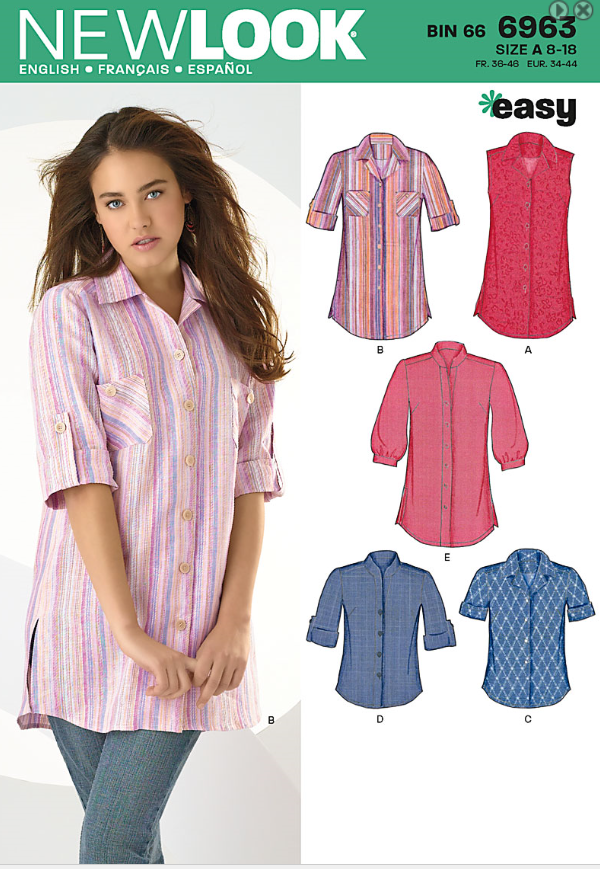
You know you look at patterns too much when you can tell that you've seen something before.


Currently in their catalog


Out of print
But before you think that I scoured the internet to find the OOP pattern, the reason I found it was because of Meine Nähmode, a German magazine that republishes Simplicity and New Look patterns. It's a great (and cheap!) way for me to obtain these patterns, although they don't always print every view and only some of the sizes, and of course I have to trace them. Oh, and the instructions are in German. But for €5.50 (about $6) I get 13 patterns.

The magazine doesn't identify which envelope patterns they reprinted but they use the pictures from Simplicity and New Look, so with a little searching I can figure it out. I then copy some of the Simplicity or New Look info into the pattern library I keep on OneNote so that I can reference it later. Since I have hundreds of patterns available through the pattern magazines I collect (along with some envelope patterns), I periodically go through my pattern library and copy info on the garments I like into a separate section. Both of these shirts were reprinted in Meine Nähmode - the OOP one in 2013 and the newest one in 2016. When I went to add the new shirt pattern to my "summer woven shirts page" I found the duplicate. But honestly when I saw that striped shirt in the latest Meine Nähmode issue I knew I'd seen it before, and I was right!

Tuesday, July 19, 2016

Ready to cut the fabric...or am I?

I'm happy with my muslin for the Knipmode tunic, so I'm ready to cut out the pattern pieces in my fabric. Or not. I've never really liked cutting the fabric. It's so final. I've ripped out many a knitted piece with hardly a second thought when things weren't going right, but you can't do that with fabric.

And before you take scissors or rotary cutter to the fabric, there are a number of things you need to do first if you want to assure success.

Prepare the fabric:

Thinking I was ready to cut, I spread out the fabric so that I could get it straighten and folded, and the first thing I noticed was that it was all creased from being stored. Step one: it needed to be pressed (don't iron back and forth - that distorts the fabric). I often don't prewash my fabrics unless the end result will be washed in warm or hot water and dried in the dryer or the fabric got dirty or something. I wash all my clothes in cold water and hang them to dry so I'm not worried about shrinking. Also, I have sometimes wound up with terribly distorted and off-grain fabric after prewashing, not to mention a ton of wrinkles.

Examine the fabric:

While ironing pressing, I had a good chance to really look at the fabric. Examining the fabric is always a good idea, in case there are flaws you need to work around. Or writing on the fabric. Not on this piece, but when I was looking at another piece of fabric I have, I was shocked to see that someone had written a number in ink pen and rubber stamped something right in the middle of the piece. It was a long-ago purchase from an online vendor and way to late to do something about it, but a lesson learned to look at your fabric as soon as you buy it or before if you're at the store.

Check for direction:

Another reason for looking over the fabric is to identify if there is a nap or direction. I've failed that one twice.

Right side vs. wrong side:

Which side of the fabric is the right side? Honestly, when you're the designer you can choose whichever side you want. There is no right side.

My fabric is a thin cotton voile, with embroidery over dotted Swiss. One side has the raised bumps of the dots, the embroidery is more vibrant and consists of chain stitches. The other side has the image of the dots, the embroidery is more subdued and is all straight stitch. Both sides would look good, so I couldn't decide. Since I've never sewn or worn dotted Swiss, I didn't know which side was intended to be the right side. A quick internet search showed that most garments are sewn with the raised-bump side (didn't find any the other way actually). I also went so far as to see if there was a picture with the invoice from when I bought the fabric to show which side was "right". Since I'm lazy and don't delete emails of stuff like that, I actually had an email. From 2007.  Yes, this has been in my stash for quite a while. There was no picture but it did show that I paid $18/yard for the fabric. Now I really don't want to mess this up, however I think it's better to use $36 dollars worth of fabric than to just store it.

Lay out the fabric:

Straighten, straighten, straighten. This step seems to take me forever because I fuss a lot with the fabric. If the selvedge is good, then I use it to help keep things straight, but sometimes it's wavy and bad. I often use the repeating motif pattern but sometimes it's printed crooked, intentionally or not.

The fabric I'm using today is a perfectionist's dream - all those little Swiss dots to line up! It's a good thing too because the embroidery designs aren't perfectly placed.

Matching patterns and repeats:

With plaids and stripes you know you'll need to be careful laying out the pieces so that things line up, but this may also be the case with prints that have repeating motifs.

The embroidery on my fabric has a definite repeat in both directions, and I decided that my tunic would look best if I maintained the same vertical placement from front to back.

Will all the pieces fit?

This is a two-part step. 1) Make sure you have all the pattern pieces and 2) make sure they all fit, taking into account any requirements for direction, pattern matching, and the number of pieces. There have been times where I cut two when I needed four, flipped a piece around the wrong way, or failed to cut something on the fold (like yesterday!). If you're using the suggested pattern layout then you're probably ok, but I always seem to do a creative pattern layout to squeeze my pieces into the fabric that I have. Or in the case of knits, I like to cut pieces out whole instead of on the fold. Still I should consult the pattern layout.

Today I had to get creative. The embroidery on my fabric doesn't extend all the way to the edges and using the suggested layout would not work. Fortunately I found a way to make everything fit. Whew!

Are there any extra non-pattern pieces to cut?

This is generally not an issue for envelope patterns but magazine patterns that you have to trace (and maybe pdf patterns too?)  almost always leave off pattern pieces that are just squares or rectangles and instead give you the dimensions you need to cut. Another reason to look at the pattern layout even if you're doing you're own thing.

One last check.

Are there any fabric motifs in less than desirable locations? Double check the direction. Look for any pattern pieces on the floor.

Take a deep breath and...

Go have a cup of tea. Eat a cookie. And decide to go blog about how many things you need to do before you can start cutting out. And now it's time for dinner, so tomorrow then.

Ready to cut...or not.

Monday, July 18, 2016

Sewing for fit

Making clothes that fit is one of my major reasons for sewing. But most of what I've sewn over the years has been out of knit fabric, or it's loose fitting, or pajamas - not much call for fit. I did make this Burda jacket/cardigan thingy, which was my first attempt at doing a full bust adjustment (FBA) on a pattern. It sort of worked but wasn't perfect.

My latest project is a tunic top from the May 2016 Knipmode (second project out that issue!). I'm using an embroidered fabric I bought a long time ago from Gorgeous Fabrics, and since I really like the fabric and brought it from my stash in the US all the way to Germany in my suitcase, I want this top to be wearable. So I'm making a muslin first so that I can make corrections for fit before I cut into the fabric.


First, let me say that tracing Knipmode patterns is a real challenge. Some time last year they started publishing every pattern in every size, from 34 to 54. I love that there no longer is a plus range - just sizes and women large and small can sew the same cute clothes. But, the downside to this is that eleven sizes are crammed onto the pattern sheet. Needless to say the lines can get a bit crazy to follow. First I study the pattern lines, making sure I know what each piece looks like and the location of any notches or marks, and then I put down sticky notes to help guide me. But it's still hard to find the lines under the tracing paper.

The first and only thing I've made from Knipmode so far was the knit top from this same issue. For that top I went by my measurements and traced and cut a size 44 with no changes (and no muslin). It came out a bit big in the upper chest, something I've had happen with Burda patterns as well. So for this tunic top I traced a 42 in the upper chest, a 44 in the mid region and blended to a 46 in the hip. Then I cut out a muslin of the front and back and quickly sewed it together, anxious to see how a 42-44-46 combo worked for me straight off the pattern. I've always heard "the drag lines point to the problem" and it's true - they were like an arrow to my "boobs". No surprise that I needed an FBA. I also needed to lower the bust dart and take in the center back seam in the upper back. You can see some of my messy adjustments on the pattern.

I did cut out one sleeve in muslin - I didn't want to waste any more of my muslin (expensive to buy here) so I only cut one. But it's important to check the fit with a sleeve because the extra weight on the shoulder can change the way the neck and chest fit.

I'm pretty satisfied with the fit now, so I think I'll proceed with cutting into my good fabric...but tomorrow because it's super hot today and hotter in the afternoon.

Oh, and there's another good reason for making a muslin first: catching stupid mistakes. When I traced the pattern, I assumed there was a center front seam and added seam allowances to the center front. I cut out the muslin assuming a center front seam but then I looked at the pattern layout in the magazine and saw that it was supposed to be cut on the fold. Instead of looking at my pattern and seeing that I had added seam allowances, I thought I'd made a huge mistake and cut at the fold line. To correct my "error" I needlessly sewed an extra strip to the front pattern pieces to make up for the "missing" seam allowance. Still not realizing the error, I made the adjustments to the pattern for the FBA (even with the erroneously added fabric at center front, I still needed one). Then I cut out a new muslin of the front piece - with the fold at the cut edge - still not seeing the seam allowances I'd added at center front! I blame the heat. Thankfully I finally caught the mistake. I stitched out the seam allowance on the muslin and the top fits better without that extra 1 1/4 inches. Imagine that.

So I think I'm good to go. No more mistakes...I hope.

Tuesday, July 05, 2016

"Free" patterns

UK magazines from the news stand are fun. The fashion magazines, like Glamour, Elle, Marie Claire often are packaged with a tube of lipstick, an eyeliner, or some other sort of beauty item - I once bought a magazine that came with a nice tube of L'Occitane hand cream. The knitting magazines often come with knitting needles or a handy notion. Cross stitch magazines can come packaged with a tiny project. I was visiting Edinburgh, Scotland over the weekend and came across this sewing magazine in the airport news stand that came packaged with two McCalls patterns:


I don't know that I would pay £8 (about $10.50) for a magazine I knew nothing about and couldn't even leaf through (since it was encased in a plastic wrapper), but the patterns sold me. Not that I need more patterns. These patterns are ones that I would actually sew, though I have to grade up since I don't think I had an option to buy a different size. The 66-page magazine is not bad either. There are short little pieces with newbie sewing advice - but useful as reminders for seasoned sewers too, both garment and non-garment sewing projects, analyses of some McCalls and Butterick patterns, and one feature article. The sewing ads are also useful and may introduce me to some new online sources. This issue also came with a printed pattern for a jersey dress, which you can also download for free when you register at makieittoday.co.uk.

German magazines sometimes have some freebies packaged with them, but not to the extent that I've seen UK magazines. It's fun to buy one every now and then but I do have to watch myself and not buy a magazine just because, you know,  free stuff.

Friday, June 24, 2016

What a difference color makes

My latest sewing projects are good examples of how different use of color can totally change the look.

My first project is actually a redo. I made this top late last summer - so late that it turned cool before I could wear it, but it was looking like I was never going to wear it anyway. I wasn't pleased with how it turned out. It fit ok but the white binding - I used a cotton/linen blend - was too stiff and too bright. I couldn't help but think "hospital gown" when I looked at it. So I changed the binding.


Before

 
After
It was a crazy amount of work to change the binding, but worth it because now I will wear the top. I used some rayon binding that is probably meant for finishing seam allowances but I think it works well as trim here, both for the color and because it's softer. I machine stitched the strip to the edges first and then hand sewed the other edge in place since it wanted to twist when I tried stitching in the ditch.

Much nicer, I think.

The second project is a top I made using two coordinating knit prints, one a print and one solid. The pattern I used is from the May 2016 issue of Knipmode - actually I used the German version "Fashion Style", but it's the same magazine.


I couldn't decide whether to use the print on top or bottom so I asked my sewing friends. They unanimously said "print on top" so that's what I did.


But look how different the shirt would look with the print on the bottom:


The use of color is ultimately a personal choice. There are no rules but there are color relationships that seem to be more or less favorable to the majority of people. When I was searching pictures on line to see other examples of two-tone shirts, I found more had the darker color on top and the lighter on the bottom, regardless of whether there were prints involved or not.

When I'm planning my sewing, knitting, or weaving projects I often get stuck on how to best use color. I have a book in my library that might help with this, and I should really take some time to read it!


Friday, June 10, 2016

Leather coin pouch - first time sewing leather

I've found that a coin pouch is almost a necessity in Europe because of the 1 and 2 Euro coins. Even if your wallet has a coin section, it quickly gets filled up - and gets heavy. 

I did not make this lovely pouch - I bought it in Buenos Aires.
My husband's coin pouch has nearly disintegrated after four years of constant use. I'd already repaired holes in it a few times but it's beyond repair now.

This was once a lovely tan pouch of soft leather.
So naturally I thought to sew a new pouch to replace the worn-out one. I never sewed leather before but always intended to, so I already had the necessary tools (of course!). I've included my pictures and process and lessons learned, in the event someone reading this would also like to make a little coin pouch.


I found the leather scrap in the remnant bin of a fabric store in Paris for 1 Euro. I bought a few pieces, but this one is perfectly sized for the small pouch. A Teflon foot is very useful for sewing leather, as are leather needles. I already had a zipper in my stash - longer is just fine. I thought I'd use heavy button thread, but it didn't work (more on that later). I drew up a paper pattern, using the old pouch as a guide. I used a pen to trace the pattern onto the wrong side of the leather.

One more useful tool for sewing leather is double sided, wash-away tape. Mine is by Dritz, but I'm sure there are other brands. The tape is useful for positioning the two pieces of the bag onto the zipper tape. You don't want to use pins because they'll put permanent holes in the leather.


Now about that buttonhole thread. I first did some sample stitching on a leftover scrap and just could not get my tension to work, despite fiddling with the tension on both the needle and the bobbin in various amounts. I tried regular thread in the bobbin only, but that didn't improve things, so I decided that either my machine, or the eye of the needle, couldn't adequately accommodate the thicker thread. Or perhaps the hole in the leather made by the needle was too small. I re-threaded my machine, a Pfaff 7570, with regular thread and got the tension set almost right away. But to me the regular machine sewing thread just seemed too skimpy for the heavy use this coin pouch will get. So I decided to increase the thread thickness by 50% by using two threads through the needle and one in the bobbin. This was easy to do because my machine has a second spindle for such a purpose. After a little adjusting I was happy with the tension and the sewing commenced.


It was actually quite easy to sew the leather. I used a 3.0 mm stitch length, and since my Teflon foot has a space for moving the needle side to side, I took advantage of that and used the edge of the foot as a guide and set the needle set the distance I wanted.

The next step was sewing the bag closed. Since my leather is very soft and not too thick, I decided to stitch it right sides together because I was pretty confident I could turn it inside out. With a thicker leather I'd sew it wrong-sides together.


I used binder clips to hold the leather together - the pin you see is only through the zipper tape. I trimmed the other end of the zipper tape so the stop wouldn't get in the way of the Teflon foot. Also, I started the stitching away from the top edge because I figured it would be next to impossible to start at the zipper edge due to the bulk. Then of course I just went back and sewed up the last bit, starting where I began the stitching. And don't forget to move that zipper pull before you sew, making sure that you can get into the bag to turn it inside out.

I did end up doing a little hand sewing at the zipper ends to secure them. I also trimmed the seam allowance so it would form a nicer curve. But then I feared that I'd trimmed it too close and envisioned coins wearing at the seam and eventually popping out the bottom, so I stitched another line of sewing in the seam allowance. I found it so easy to sew the leather, even in such a narrow space of the trimmed seam allowance (probably 1/8 inch) - there was no shifting at all.

And Voila! One new leather coin pouch.


If I make this pouch again - we'll see how long this one lasts - I would maybe line it. I noticed that the suede finish on the wrong side of the leather had made my hands a little black from handling it so much. I warned my husband about that. The pouch I bought in Buenos Aires has what looks like interfacing on the inside but I wondered if that was because they'd used a thinner leather. I noticed that the top edge where it's attached to the zipper is actually turned under (stitched right side to the zipper). If I'd done that, the seam would have been too bulky. Also, I might make the zipper end a bit neater, although the worn-out pouch was made pretty much the same way. On my Buenos Aires pouch the zipper ends are covered by the interfacing/lining.

All in all, I'd call it a successful first time sewing leather!